


The googly, perhaps the most mischievous creation in cricket history, is a delivery that spins completely unexpectedly – if you’ve ever watched a legspin bowler bamboozle an unsuspecting batsman to shoe-poke one back which supposedly spun outside instead of the inside. Until it pitches, nothing is different to a normal leg-spin delivery, and then it does exactly the opposite from what everybody was expecting. For over 120 years, it has been fooling batsmen and still does.
So where did you find this clever trick? But who invented it and why the weird name? Here is the entire story – In Which Country Was The Googly Invented? and how it was born and then followed its evolution into one of the most respected weapons in modern-day cricket.
In Which Country Was The Googly Invented?
If you are searching about it, in which country was the Googly invented? Universally, England is credited as the first that gave us the googly. England cricketer Bernard James Tindal Bosanquet invented this delivery. He developed it in England, exhibited early versions in domestic cricket, and later employed it on the international stage when he represented the England national cricket team.
The googly eventually became a favored weapon for bowlers from South Africa, Australia, India, Pakistan, and nearly every other cricket-playing nation’s arsenal as well, but its roots are firmly in England.
History of Googly
The actual delivery was devised in England, but the word “googly” itself is thought to have been first used on the far side of the world. Bosanquet’s new delivery was so notable during Lord Hawke’s cricket tour of New Zealand in the 1902–03 season that it became known as a “googly.” The cricketer Pelham Warner writes that the term was first used – by the Lyttelton Times, a newspaper in Canterbury, New Zealand.
As for where the word itself came from, there appears to be no consensus-and this is part of the charm of cricket history. A few theories exist:
- Some say it has a Maori origin, as picked up on the New Zealand Tour.
- And some say that it derives from “guile,” which means deceit or cunningness, which is surely apt as the googly is all about deceiving the batsman.
- The third, from googler- an old cricketing term for a high, floaty, flighted delivery and not too far off what a googly looks like before it does its unexpected business.
Whatever the real source, though, the name took and became established quickly; within a few years “googly” was pretty much the ubiquitous term for different types of delivery used by bowlers at cricket grounds around the world.
Who Was Bernard Bosanquet?
Bernard Bosanquet (1877-1936) was born on 13th October 1877 in Enfield, Middlesex, into a fairly successful family. His father was a banker and businessman who went on to serve as High Sheriff of Middlesex, while his grandfather was a prominent biblical historian. Even his uncle of the same name was a great philosopher. Bosanquet was from a family that made its mark – no one could have predicted he would be just the same as he invented cricket delivery. He actually began debuting as a batsman interestingly. He began as a medium-pace bowler who could bat reasonably well. It was rather out of pure inquisitiveness and playful experimentation than any serious training regimen that he became the master of one of cricket’s most iconic deliveries.
| Attribute | Details |
| Full Name | Bernard James Tindal Bosanquet |
| Born | 13 October 1877, Bulls Cross, Enfield, Middlesex, England |
| Died | 12 October 1936, Wykehurst, Ewhurst, Surrey, England (aged 58) |
| Role | All-rounder |
| Batting Style | Right-handed batsman |
| Bowling Style | Right-arm leg-break and googly (inventor of the googly) |
| Education | Eton College; Oriel College, Oxford University |
| First-Class Career | 1898–1919 (mainly for Middlesex) |
| First-Class Matches | 235 |
| Runs Scored | 11,596 (average 33.41) with 21 centuries |
| Wickets Taken | 629 (average 23.80) with 45 five-wicket hauls |
| Test Career | 7 Tests for England (1903–1905) |
| Test Wickets | 25 (average 24.16) |
| Major Achievement | Wisden Cricketer of the Year (1905); First player to score a century in each innings and take 10+ wickets in the same first-class match |
| Legacy | Inventor of the googly, a revolutionary leg-spin delivery that spins the opposite way to a normal leg-break |
Myths About The Delivery “Googly’
- Myth: The Googly is an off-spinner delivery.
- Truth: wrong ‘googly’ belongs to leg-spinners only! A standard leg-break from a right-arm leg spinner turns from leg to off (away from a right-handed batsman). The Googly: the surprise delivery spinning into leg is their surprise variation.
- Myth: The bowler modifies their run-up to bowl it.
- Truth: A googly is purely an art of deception A normal legbreak is bowled by the bowler at similar run-up, arm speed and action. The spin only comes by a quick flick of the wrist and fingers right when it is released.
- Myth: The word “googly” originated in England.
- Truth: This delivery was invented in England by Bernard Bosanquet in 1900, but the term “googly” was most probably introduced across the ditch in Australia. It comes from the Australian slang term “googie,” which means egg and that resembles our high and low bounce.
- Myth: The googly is modern creation.
- Truth: The googly is more than 125 years old. It was invented as a party trick by Bosanquet in the late 1890s of which he then reserved for competitive cricket.
What Brought the Googly into Existence?
Which is where the fun part of the story comes in, because nobody molded him into a googly bowler. It was born out of a game.
Bosanquet himself described how, shortly before 1897, he was playing a parlour game called “Twisti-Twosti” with a tennis ball. The concept was basic: bounce the ball on a table, so that the person opposite you would not be able to catch. You are given a rubber ball without a perfect bounce but Bosanquet was just experimenting with variations of bend in the wrist to make the ball jump at all angles and here he struck gold. With a few degrees of alteration to his wrist at the moment of release, he discovered that he could turn an apparent arm-ball into a delivery that spun in the other direction.
Then there is an alternative family account, recounted years later by a nephew, which pushes the experiment back further, around 1890. when Bosanquet and his brother attempted to spin a ball on a striped billiards table one rainy afternoon. Whatever precise version is true, the clear commonality is that the googly was born as a game, not as an intentional cricketing strategy at all. He just enjoyed bouncing things in unconventional ways, and then wondered what if this technique could also be used to bounce a real cricket ball.
He practiced this skill in silence for some time, aided by exceedingly large fingers, which turned out to be needed to conceal the delivery properly. For a long time, almost no one — or even his family members — knew what he was working on.
When Did He First Use the Googly?
The googly was delivered for the first time ever in a proper match on 20th July 1900 during a first-class clash between Leicestershire and Middlesex. Plum Warner, who was obviously captain of the side at that time, gave Bosanquet the ball after he had already made 136 with the bat in the innings. Battling beautifully was Leicestershire’s Samuel Coe, who had reached 98 and was two runs short of a century.
Bosanquet ran in and delivered what appeared to be a slow, loopy ball. Coe had rushed down the pitch to play it, anticipating an easy run. This was no typical leg-break, however. The ball spun sharply the other way, bounced unexpectedly, and left Coe stranded. He was stumped two runs shy of a Test century that should have been a comfortable milestone.
The excitement was palpable, but Bosanquet played a very smart game. Instead of disclosing this was a deliberate innovation from scratch, he left people to speculate it could have been an accident. The secrecy helped him here, because a batsman can’t prepare for what he assumes is an accident rather than a true variation weapon. For months now he has used it just lightly, adding intrigue to the weaponry before unleashing it at full force on international cricket.
How Does a Googly Work Actually?
However, here is the short version for those who don’t understand cricket that well. After pitching, a classic leg-spin delivery (bowled by a right-arm bowler) turns from the batsman when bowling to a right-handed batsman. A googly comes out of the bowler’s hand looking exactly like a normal leg spin delivery, same arm action, same kind of loop but at the last moment he gives his wrist a little twist. This creates inward movement of the ball after pitching, making it spin in the opposite direction to its natural course exit.
The action looks so much like a normal leg-break, that the batsman hardly gets any indication at all. They practice for one shot only, and the ball does something else completely. There you have exactly that which had Coe stumped in 1900, and precisely that which still baffles top batsmen.
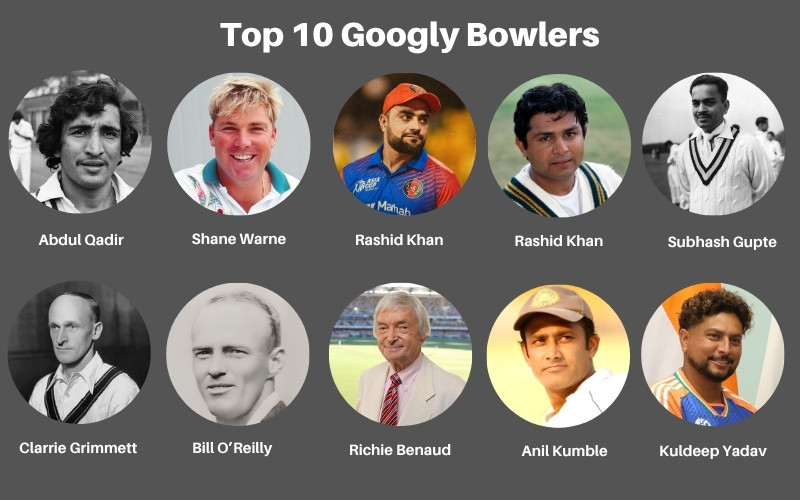
Top 10 Googly Bowlers
| Bowler | Country | Era | Why he is in the top 10 |
| Abdul Qadir | Pakistan | 1977–1993 | One of the greatest pure googly/wrist-spin artists. ICC describes him as a bowler whose name became strongly attached to the art of leg spin. |
| Shane Warne | Australia | 1992–2007 | The greatest modern leg-spinner. He did not rely on the googly as much as others, but his leg-break, flipper, top-spinner and deception revived wrist-spin globally. |
| Rashid Khan | Afghanistan | 2015–present | The best modern googly exponent. He often uses googlies more than leg-breaks and has turned it into a reliable weapon. |
| Mushtaq Ahmed | Pakistan | 1989–2003 | A classic Pakistani leg-spinner with “googlies aplenty,” heavily influenced by Abdul Qadir. |
| Subhash Gupte | India | 1951–1961 | One of India’s finest wrist-spinners, famous for sharp turn and reportedly two different googlies. |
| Clarrie Grimmett | Australia | 1925–1936 | Early great of leg-spin and googly bowling; also associated with the development of the flipper. |
| Bill O’Reilly | Australia | 1932–1946 | A fast, aggressive leg-break/googly bowler and one of the most feared spinners of his era. |
| Richie Benaud | Australia | 1952–1964 | A smart leg-spinner with a well-disguised googly and top-spinner; also one of cricket’s most influential tactical minds. |
| Anil Kumble | India | 1990–2008 | Not a big-turning googly bowler, but a highly effective legbreak-googly bowler with 619 Test wickets and major match-winning impact. |
| Kuldeep Yadav | India | 2017–present | Modern left-arm wrist-spinner with a dangerous googly; his googly has been repeatedly highlighted as difficult to pick. |
A Hidden-Factor to a Cricketing Fundamental of googly
As soon as the googly went public, it didn’t take long for it to leave England. By the early 1900s, South African bowlers had quickly grasped this (teaching them to avoid a hidden googly and turn it into a genuine attacking weapon as opposed to something of novelty). It gradually made its way to Australia, through the West Indies, India and Pakistan and every other cricketing nation in between, settling down as a staple in the arsenal of any serious leg-spinner.
It has since been exploited masterfully by some of the finest spin bowlers ever to play the game over the next few decades. Some of the great names in the profession such as Shane Warne and Anil Kumble made a big name for themselves by hiding a googly inside ordinary leg-breaks, which left even Virat Kohli or Sachin Tendulkar thinking. The googly has become even more precious in shorter formats like T20s and One Day Internationals because batsmen simply have less time to read the ball and adjust their shot.
Conclusion
To sum it all up: the googly was created in England by Bernard Bosanquet, who started playing around with his grip around 1897. Officially, it was first bowled in a match on July 20, 1900, acquired its odd name while on tour in New Zealand two years later, and then made its way around the cricketing globe to become one of the great stand by deliveries in the game.
Over a hundred years later, every time a leg-spinner fools a batsman with a ball that turns the “wrong” way they are continuing an act that began as nothing more than an Englishman curious to see if he could make the tennis ball bounce off his table in such a way that it fooled whoever was seated opposite.
FAQ’S
England.
Bernard Bosanquet: English cricketer (1877 – 1936).
20th July 1900, in a Middlesex vs Leicestershire match
By experimenting with wrist position while playing a tabletop ball game called “Twisti-Twosti.” We figured it was about time to track down where “googly” came from; you’re welcome!
No. A leg-break spins away from the batsman; a googly looks the same but spins back in, making it deceptive.
Also Read,
Shreyanka Patil Biography, Age, Height, Family, Career, WPL Stats, Net Worth & More